Introduction
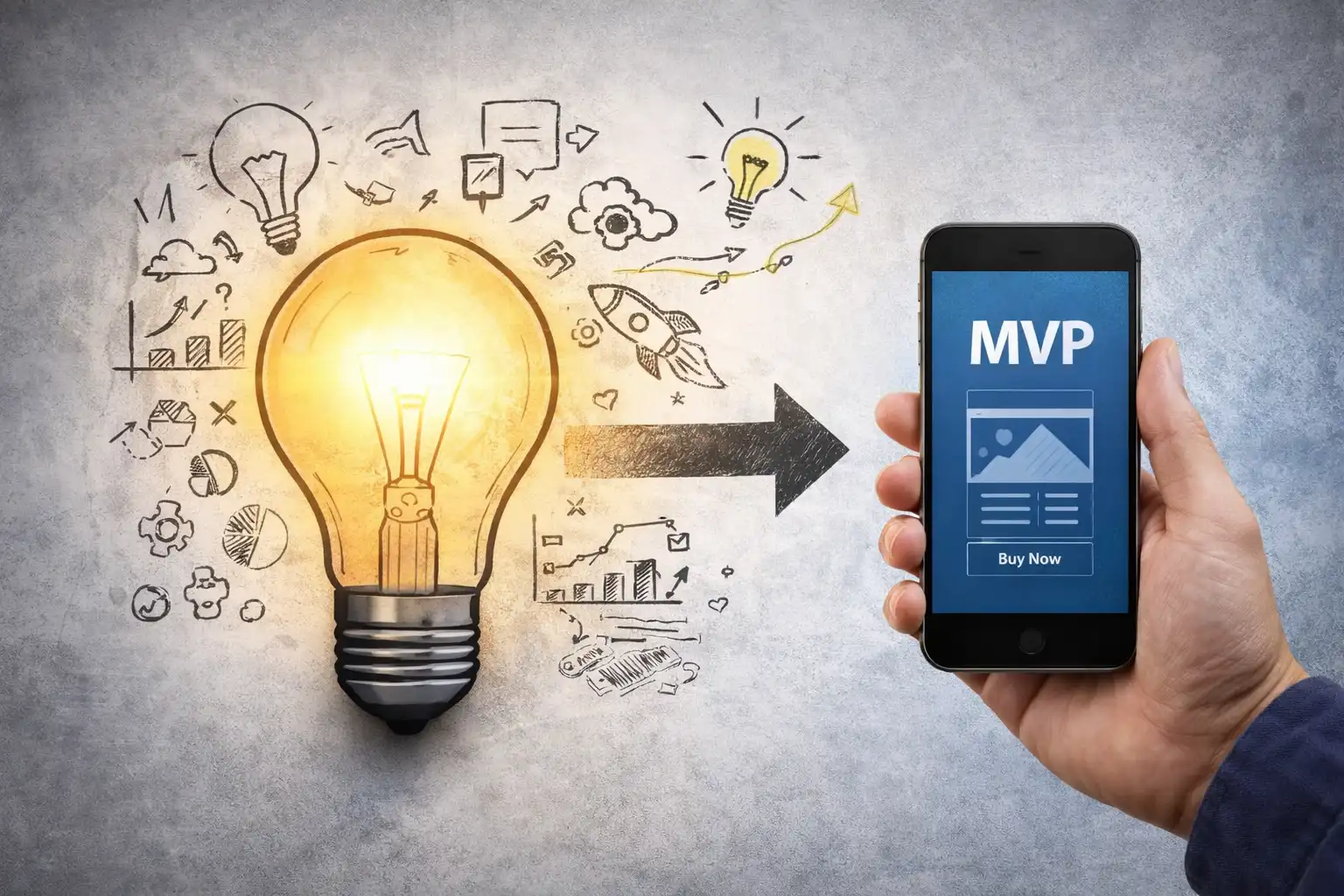
You have an idea that could change everything. Maybe it solves a problem you've experienced firsthand, or you've spotted a gap in the market that others have missed. The excitement is real—but so is the challenge of turning that vision into something tangible.
The journey from idea to product has derailed countless startups. Some build too much, burning through runway before finding product-market fit. Others build too little, launching something so bare it fails to demonstrate value. The sweet spot—a true Minimum Viable Product—requires discipline, clarity, and the right approach.
This guide walks you through the practical steps of building an MVP that validates your assumptions without wasting time or money. If you're also wondering about budget, check out our detailed guide on the real cost of building a mobile app in 2025.
What Is an MVP (Really)?
The term "Minimum Viable Product" gets misused constantly. It's not a half-finished product. It's not a prototype. It's not the first version of your final product with features removed.
An MVP is the smallest thing you can build that allows you to learn whether your core assumption is valid.
The key words:
- Minimum: Only what's essential to test your hypothesis
- Viable: Functional enough that real users can actually use it
- Product: Something people can interact with, not just a mockup
What an MVP Is NOT
It's not a feature list cut in half. Starting with your dream product and removing features until it fits your budget is not MVP thinking. You'll end up with a compromised version of something instead of a focused experiment.
It's not a demo. Demos show capability. MVPs test assumptions with real users making real decisions.
It's not throwaway code. While you shouldn't over-engineer, your MVP should be built on foundations you can extend. Complete rewrites are expensive and demoralizing.
Step 1: Validate Before You Build
The most common mistake founders make is building before validating. Code is expensive. Conversations are cheap.
Talk to Potential Customers
Before writing a single line of code, have at least 20 conversations with people who fit your target customer profile. Not friends and family—actual potential customers.
Ask about:
- How they currently solve the problem you're addressing
- What frustrates them about existing solutions
- What they've tried that didn't work
- How much time/money the problem costs them
Listen more than you pitch. Your goal is understanding, not convincing.
Identify Your Riskiest Assumption
Every startup is built on assumptions. Your job is to identify the one assumption that, if wrong, kills everything—and test it first.
Common risky assumptions:
- "Users will pay for this" (willingness to pay)
- "Users will switch from their current solution" (switching costs)
- "This technology can actually work at scale" (technical feasibility)
- "Users will trust us with their data" (trust barriers)
Test Without Building
Many assumptions can be tested without building a product:
Landing page tests: Create a page describing your solution with a "Sign Up" or "Join Waitlist" button. Measure conversion rates.
Concierge MVP: Manually deliver your service to early customers before automating. Zappos founder Nick Swinmurn validated shoe-buying demand by photographing shoes at local stores and buying them at retail when orders came in.
Wizard of Oz MVP: Present an automated interface to users while manually performing the work behind the scenes. This tests whether users want the outcome before you invest in automation.
Step 2: Define Your Core Value Proposition
An MVP needs focus. You can't test everything at once. Identify the single most important value your product delivers and build only what's necessary to deliver that value.
The One-Sentence Test
Can you describe your product's value in one sentence? If you need paragraphs, you're not focused enough.
Good: "Instantly see how any dish looks and tastes before ordering at a restaurant." (This is exactly what we built with PlateMate—a focused MVP that nailed one core value.)
Too broad: "A platform that revolutionizes the dining experience through AI-powered recommendations, social reviews, dietary tracking, and restaurant analytics."
Prioritize Ruthlessly
List every feature you can imagine. Then categorize:
Must Have: Without this, the core value proposition doesn't work Should Have: Significantly improves the experience but isn't essential Nice to Have: Would be cool, maybe useful, but not critical Won't Have (for now): Future features, explicitly out of scope
Your MVP includes only the Must Haves. Everything else waits.
Step 3: Choose the Right Tech Stack
Technology decisions made now will compound over time. Choose wisely, but don't overthink it.
Principles for MVP Tech Choices
Speed over perfection: Choose technologies your team knows well. Learning a new framework during MVP development adds risk and slows you down.
Proven over cutting-edge: Trendy technologies often lack documentation, community support, and stability. Boring technology has well-understood failure modes.
Flexibility over optimization: You don't know what you'll need to change. Choose architectures that adapt easily.
Common MVP Tech Stacks
Web Applications:
- Nuxt/Next.js for full-stack JavaScript
- Ruby on Rails for rapid development
- Django for Python teams
Mobile Apps:
- React Native or Flutter for cross-platform (learn more in our Flutter development guide)
- Native (Swift/Kotlin) only if platform-specific features are critical
Backend:
- Node.js for JavaScript consistency
- Python for AI/ML integration
- Serverless functions for simple APIs
Build vs. Buy
For non-core functionality, strongly prefer buying or using existing services:
- Authentication: Auth0, Clerk, Firebase Auth
- Payments: Stripe, Paddle
- Email: SendGrid, Resend
- Analytics: Mixpanel, Amplitude, PostHog
- Hosting: Vercel, Railway, Render
Every hour spent building commodity features is an hour not spent on your unique value proposition.
Step 4: Design for Learning
Your MVP exists to answer questions. Design it to generate clear answers.
Define Success Metrics
Before launching, decide what success looks like. Specific, measurable goals:
- "50% of users who view a menu item will view the AI recommendation"
- "20% of users will return within 7 days"
- "10% of beta users will convert to paid within 30 days"
Build in Analytics
Instrument your MVP to capture the data you need:
- User actions (clicks, scrolls, feature usage)
- Funnel progression (signup → activation → retention)
- Error rates and performance metrics
You can't improve what you can't measure.
Create Feedback Loops
Make it easy for users to tell you what's working and what isn't:
- In-app feedback widgets
- Post-session surveys (keep them short)
- Direct communication channels (Slack, Discord, email)
Early users who take time to give feedback are gold. Treat them accordingly.
Step 5: Build Incrementally
Waterfall development—planning everything upfront and building in sequence—doesn't work for MVPs. Too many assumptions change along the way.
Two-Week Cycles
Break development into two-week iterations:
- Plan: Define what you'll build and what questions it will answer
- Build: Develop the features
- Test: Get it in front of real users
- Learn: Analyze results and adjust plans
Each cycle should produce something usable, even if incomplete.
Vertical Slices
Build complete features rather than horizontal layers. Instead of building "the entire database schema" or "all the UI screens," build one complete user flow from interface to database.
This approach:
- Reduces integration risk
- Produces demonstrable progress
- Allows earlier user testing
Ship Early, Ship Often
The longer you wait to ship, the more assumptions accumulate untested. Deploy frequently—daily if possible. Use feature flags to control what users see.
Step 6: Launch and Learn
Your MVP isn't done when it's built. It's done when you've learned what you set out to learn.
Soft Launch First
Don't announce to the world on day one. Start with a small group of beta users:
- Easier to provide high-touch support
- Bugs impact fewer people
- Feedback is more detailed and actionable
Gather Qualitative and Quantitative Data
Numbers tell you what's happening. Conversations tell you why.
Quantitative: Track your predefined metrics. Where do users drop off? Which features get used?
Qualitative: Watch users interact with your product. What confuses them? What delights them?
Iterate or Pivot
Based on what you learn, you'll do one of three things:
Persevere: The data supports your assumptions. Keep building on this foundation.
Iterate: The core is working but needs refinement. Adjust and test again.
Pivot: The fundamental assumption was wrong. Change direction while preserving what you've learned.
None of these outcomes is failure. The only failure is not learning.
Common MVP Mistakes to Avoid
Building for Scale Prematurely
"What if we get a million users?" You won't—not at launch. Build for hundreds of users first. Scale problems are good problems to have.
Perfectionism
Your MVP will have bugs. The UI won't be perfect. Some edge cases won't be handled. Ship anyway. Perfect is the enemy of shipped.
Ignoring Business Model
Even if you're not charging yet, understand how you'll eventually make money. An MVP that validates user interest but can't support a business model hasn't validated the right thing.
Building in Isolation
Founders who disappear for months to build often emerge with something nobody wants. Stay connected to users throughout development.
When to Bring in Help
Building an MVP requires diverse skills: product thinking, design, development, and user research. Few founders have all of these.
Consider partnering with a development team if:
- Speed matters: Experienced teams ship faster than first-time builders
- Technical complexity is high: AI, real-time features, or complex integrations benefit from expertise
- You want to focus on business: Your time might be better spent on customers, fundraising, or strategy
The right partner acts as an extension of your team, not just a vendor executing specifications. See how we've helped startups launch products like Gromo, PeerPicks, and Stellar Fate AI.
Conclusion
Building an MVP is an exercise in disciplined focus. It's about resisting the urge to build everything you envision and instead building just enough to learn whether your vision is valid.
Start with validation. Define your core value proposition. Choose proven technology. Design for learning. Build incrementally. Launch early. And most importantly—listen to what real users tell you through their actions.
The path from idea to successful product is rarely straight. But with a proper MVP approach, each step forward is grounded in evidence rather than assumption. That's the difference between startups that succeed and those that simply run out of money building the wrong thing.
Your idea deserves a fair test. An MVP is how you give it one.
Ready to turn your idea into reality? Let's talk about your MVP. We've helped dozens of founders go from concept to launched product—and we'd love to help you too. Explore our app development services or view our portfolio for inspiration.